What Is the Sammamish Real Estate Market Doing Right Now?
If you own a home in Sammamish and you've been watching the market — or if you're a buyer who's been sitting on the sidelines trying to figure out whether now is the right time to move — here's the honest picture of what's actually happening.
The Sammamish market has shifted. Not collapsed. Not crashed. Shifted. And understanding exactly what that shift means for your situation is the difference between making a good decision and making an expensive one.
I'm Maggie Vreeburg. I've been a Sammamish real estate agent for 35 years. I've watched this market through interest rate cycles, economic uncertainty, hot streaks, and slow stretches. What's happening right now is real, it's measurable, and it's navigable — if you understand it honestly.
The Numbers, Right Now
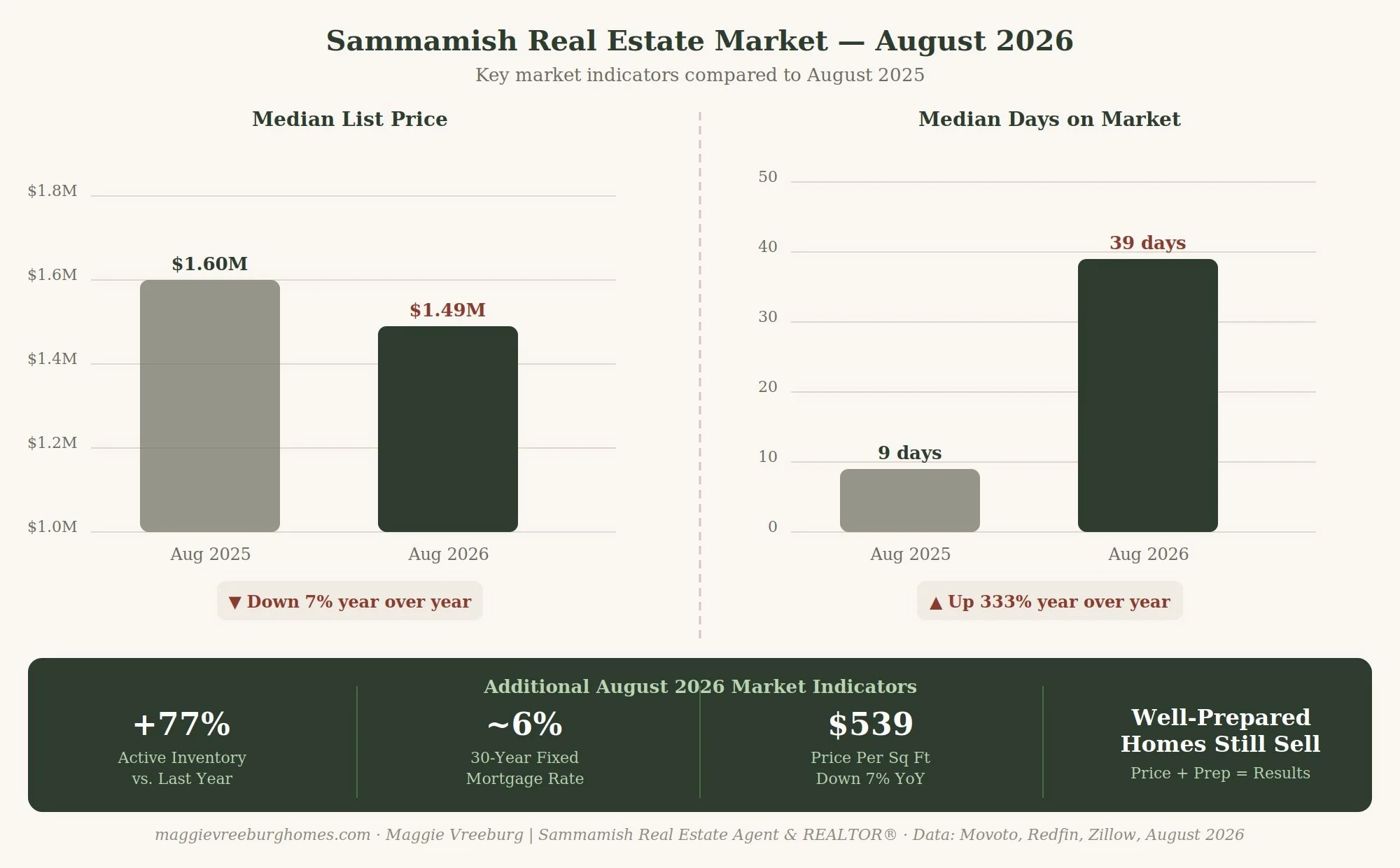
Let's start with what the data actually says about the Sammamish market in August 2026.
Median home price: Approximately $1.49 million as of August 2026 — down approximately 7 percent from August 2025. That's a meaningful shift from the peak, not a dramatic collapse. For context, Sammamish homes were selling above $1.6 million in spring 2026. The market has pulled back from those numbers.
Days on market: Homes are averaging 39 days on market in August 2026 — up significantly from the 5 to 9 days that defined the frenzy years. That's a real change. It means buyers have time to think, compare, and negotiate in ways they simply couldn't before.
Inventory: Active listings are up approximately 77 percent from a year ago. Buyers have real choices right now. That is the single biggest structural change in this market. When inventory was thin, sellers had leverage. When inventory is thick, buyers do. That's where we are.
Price per square foot: Approximately $539 per square foot in August 2026, down approximately 7 percent year over year.
Mortgage rates: Hovering around 6 percent for a 30-year fixed loan as of mid-2026 — elevated by historical standards but stable, and forecasts point to possible moderate decreases by year end.
These numbers tell a consistent story: this is a more balanced market than Sammamish has seen in several years, with more inventory, longer days on market, and prices that have softened meaningfully from their peak without signaling anything like a distressed market.
What This Market Is — And What It Isn't
Let me be direct about what this data does and doesn't mean, because the interpretation matters as much as the numbers.
This is not a buyer's market in the traditional sense. Sammamish has too many structural strengths — top school districts, a safety profile that's unmatched in Washington state, proximity to the Eastside tech corridor, a community infrastructure that took decades to build — for the market to behave like a distressed market. The underlying demand for this specific place is durable. Families keep moving here because the reasons to live here haven't changed.
This is also not the seller's market of 2021 and 2022. The days of listing a home on Thursday and choosing from six offers on Monday are largely gone for anything but the most exceptional, best-priced properties. The market has genuinely cooled. Sellers who approach it like it's still 2022 are getting a hard lesson.
What this is: A market where preparation and pricing matter more than they have in years, where buyers have real options and real time to use them, and where the gap between homes that sell quickly and homes that sit is wider than it's ever been in recent memory.
That gap is not random. It's not luck. It's specific and identifiable — and it has everything to do with how a home is priced and prepared before it goes live.
What It Means If You're a Seller

If you're thinking about selling — whether now, this fall, or in the next six to twelve months — here's what today's market requires from you.
Accurate pricing is no longer optional. In a market with 77 percent more inventory than a year ago, buyers are comparison shopping carefully. They know what comparable homes are selling for. They move quickly past homes that look expensive relative to their competition. An overpriced listing in today's Sammamish market doesn't just sit — it accumulates days on market in a way that makes buyers suspicious and negotiating room that eats into your net proceeds.
The sellers who are succeeding right now priced their homes based on what buyers are actually paying today — not what a neighbor got eight months ago, not what a Zestimate says, not what they need to net. In my experience, Zestimates in this market run $25,000 to $75,000 off in either direction. What you actually need is a Comparative Market Analysis built from recent, truly comparable sales in your specific neighborhood.
Preparation has never mattered more. When buyers have 39 days to decide instead of 39 hours, they notice everything. The smell when the door opens. The burned-out bulb in the dining room. The yard that hasn't been touched since spring. The carpet that needs replacing. In a frenzy market, buyers overlook these things because they're afraid of losing the home to another buyer. In today's market, they use them as reasons to wait, walk away, or negotiate down.
The homes selling quickly right now came to market genuinely prepared — cleaned, staged, maintained, with curb appeal that says someone cares about this place. That's not expensive to achieve. It requires time and attention. But the cost of not doing it shows up clearly in your final sale price.
Timing still matters — but not the way most sellers think. Fall in Sammamish has historically been underrated. September through November brings motivated buyers — families settled after the school year started, tech workers with year-end bonuses to deploy, relocating buyers who need to be established before winter. Inventory typically drops as sellers pull listings before the holidays, which improves the competitive landscape for homes that remain well-positioned.
The sellers who wait until spring are making a bet that conditions will improve significantly enough to justify missing the fall window. In my experience, that bet costs more than it saves more often than not.
"For the full breakdown of what sellers can do right now to compete in today's market, I've written that in detail separately." → https://www.maggievreeburghomes.com/blogs/what-can-i-do-to-sell-my-home-in-todays-sammamish-market
What It Means If You're a Buyer
If you've been watching the Sammamish market from the sidelines — waiting for prices to drop further, waiting for rates to improve, waiting for a clearer signal that it's the right time — here's what the current data actually says.
The window of buyer opportunity is real. More inventory than a year ago. More time to make thoughtful decisions. More negotiating room than existed during the frenzy. Sellers who are priced right and motivated are having real conversations about terms — on price, on closing costs, on closing timelines — that simply weren't possible in 2021 and 2022.
The homes worth having are still moving. The 39-day average days on market hides enormous variation. Well-priced homes in strong school district boundaries — the ones that check all the real boxes for the right buyer — are still generating interest and offers faster than the average suggests. A buyer who assumes the entire market is slow and takes too long to act will lose the homes worth having to buyers who moved decisively.
Rates are stable and forecasts point modestly lower. The 30-year fixed rate hovering around 6 percent is elevated by historical standards but it's been stable, and forecasts from the Mortgage Bankers Association point to possible moderate declines by year end. Nobody can guarantee where rates go from here. What I can tell you is that waiting for a dramatic rate decrease while the market shifts is a strategy that has historically cost buyers more than it saved them.
The buyers who look back on this period with satisfaction won't be the ones who timed the market perfectly. They'll be the ones who were financially ready, moved thoughtfully, and stopped waiting for conditions that might never come.
"For the honest rent vs. buy analysis in today's Sammamish market, I've covered that separately." → https://www.maggievreeburghomes.com/blogs/should-i-rent-or-buy-in-sammamish-right-now-the-honest-answer
The Neighborhood Picture
Not all of Sammamish is behaving the same way. The market varies significantly by neighborhood and price point — which is one of the most important things to understand before making any decision based on market-level data.
Homes in the $900,000 to $1.2 million range — primarily townhomes and smaller single-family homes — are moving more actively than the upper price ranges. This segment has more buyer demand relative to supply, partly because these homes sit closer to or below the jumbo loan threshold and attract a wider pool of qualified buyers.
Homes in the $1.5 million to $2 million range — the core of the Sammamish single-family market — are where the softening is most visible. This is where the 39-day average days on market is most concentrated, where price reductions are happening, and where the gap between well-prepared and under-prepared listings is widest.
Homes above $2 million in neighborhoods like Trossachs, Sahalee, and Inglewood Hill represent a specialized market with fewer buyers, longer timelines, and greater sensitivity to both pricing and condition.
School district boundary assignment continues to be one of the strongest value drivers regardless of price point. Homes in the Eastlake High School and Skyline High School boundaries, with their documented school quality advantages, command consistent demand even in a softer market. Address-specific school assignment — not just neighborhood name — is the detail that matters most for families driving their search around education.
"For a full breakdown of which Sammamish neighborhoods feed into which schools and what that means for value, I've covered that separately." → https://www.maggievreeburghomes.com/blogs/which-sammamish-neighborhoods-have-the-best-schools
What I'm Watching for Fall 2026
A few things will shape how the Sammamish market behaves over the next 90 days.
Interest rates. Any meaningful movement — up or down — changes the buyer pool. A drop toward 5.75 percent would meaningfully expand the number of qualified buyers. A spike above 6.5 percent would further suppress demand. Neither is my prediction — it's simply the variable that matters most to market momentum right now.
Inventory behavior. Sellers who didn't sell this summer are making decisions right now about whether to push through fall or pull their listings before the holidays. If sellers pull back significantly, inventory tightens and the remaining buyers compete for fewer homes — which is good for sellers who stay the course. If inventory stays elevated through October and November, the buyer advantage extends.
The employment picture. Sammamish's buyer pool is concentrated in the Eastside tech corridor. Any meaningful shift in tech employment — hiring cycles, return-to-office mandates, new campus investments — affects who is moving to or from this market. Microsoft's 2026 return-to-office policy has been driving relocation demand that's visible in the numbers. Watch for any changes to that policy.
Common Questions Right Now
Is now a good time to sell in Sammamish? Yes — with the right preparation and pricing. The sellers who are succeeding in this market came in prepared, priced accurately, and executed well. The sellers who are struggling overpriced their homes or under-prepared them for today's more selective buyers.
Is now a good time to buy in Sammamish? For buyers who are financially ready — with solid financing, clear neighborhood priorities, and a genuine three to five year commitment to the area — yes. The combination of more inventory, more time, and more negotiating room represents real opportunity that didn't exist two years ago.
Will prices drop further? Nobody knows. The structural factors that support Sammamish home values — supply constraints, school district quality, Eastside employment proximity — haven't changed. What has changed is the affordability ceiling imposed by elevated interest rates and peak pricing. If rates decrease meaningfully, prices could firm. If rates stay elevated, the current softening may continue modestly.
Should sellers wait until spring? In my experience, sellers who wait for a better market usually find that the better market didn't arrive — or arrived later than they expected and cost them more than they saved. Fall buyers in Sammamish are genuinely motivated. Spring brings more competition from other sellers. The right answer depends on your specific situation, not on a general market forecast.
Common Mistakes People Are Making Right Now
Sellers testing the market at an aspirational price. In a market with significantly more inventory and 39-day average days on market, an overpriced home doesn't attract the right buyer and wait — it accumulates days on market that work against the final price. Honest pricing from day one is the strategy that works right now.
Buyers waiting for a dramatic price correction. Sammamish is a supply-constrained plateau with strong structural demand. Major corrections require sustained, significant oversupply. The current softening reflects rate pressure and affordability ceiling — not a fundamental breakdown in demand for this specific place.
Both sides making decisions based on market averages rather than specific comparable data. The 39-day average and the $1.49 million median tell you something about the market overall. They don't tell you what your specific home is worth, or what a specific home you want to buy is worth, relative to genuinely comparable properties in the same neighborhood and school boundary. Specific data beats general data every time in a market this specific.
"For the honest picture of why some Sammamish homes are selling while others sit, I've written that separately." → https://www.maggievreeburghomes.com/blogs/why-is-my-sammamish-home-not-selling-when-other-homes-are
Frequently Asked Questions
What is the Sammamish real estate market doing right now? As of August 2026, the Sammamish market has softened meaningfully from its peak. Median home prices are approximately $1.49 million, down about 7 percent from a year ago. Homes are averaging 39 days on market. Active inventory is up approximately 77 percent from a year ago. Well-prepared, accurately priced homes are still selling. Under-prepared and overpriced homes are sitting.
Are Sammamish home prices going up or down? Down modestly from their peak. Median prices are off approximately 7 percent from August 2025. This reflects real affordability pressure from elevated interest rates and a market that ran hard during the low-rate years. It does not reflect a structural collapse in demand. Analysts broadly expect prices to stabilize rather than continue declining sharply, particularly if interest rates decrease.
How long are homes sitting on the market in Sammamish? The median days on market in August 2026 is approximately 39 days — up significantly from the 5 to 9 days that characterized the peak market. This average hides significant variation: well-positioned homes in strong school boundaries are still moving faster, while overpriced or under-prepared homes are pulling the average up.
Is it a buyer's or seller's market in Sammamish right now? Neither purely. Inventory is up significantly, which gives buyers more choices and negotiating room than they've had in years. But Sammamish's structural strengths — schools, safety, employment proximity — support values in a way that prevents this from becoming a true buyer's market. Sellers who price and prepare correctly are still finding success. Buyers who are ready and decisive are finding opportunity.
What's the best strategy for selling in Sammamish right now? Price accurately based on current comparable sales, not peak comps or Zestimates. Come to market genuinely prepared — cleaned, staged, maintained, with curb appeal that competes. Launch with professional photography and strong marketing. And move decisively on price if the market tells you something in the first two weeks. The sellers succeeding right now did all four of these things.

Ready to Talk Through What This Means for Your Situation?
Market data tells you what's happening broadly. It doesn't tell you what the right move is for your specific home, your specific situation, and your specific goals.
That's the conversation worth having. Whether you're thinking about selling this fall, trying to decide whether to buy now or wait, or just trying to make sense of what you're seeing in your neighborhood — an honest read on where you stand is more valuable than any market report.
Dig with the right questions, stop talking, and actually listen to what the situation calls for. That's when the right answer takes shape. That's when I come in.
Maggie Vreeburg | Sammamish Real Estate Agent & REALTOR®maggievreeburghomes.com 425-417-4663 Hello@MaggieVreeburgHomes.com
